Strategy
Why Your Clients' Blog Posts Aren't Generating Leads (And the One Fix That Doesn't Require More Writing)
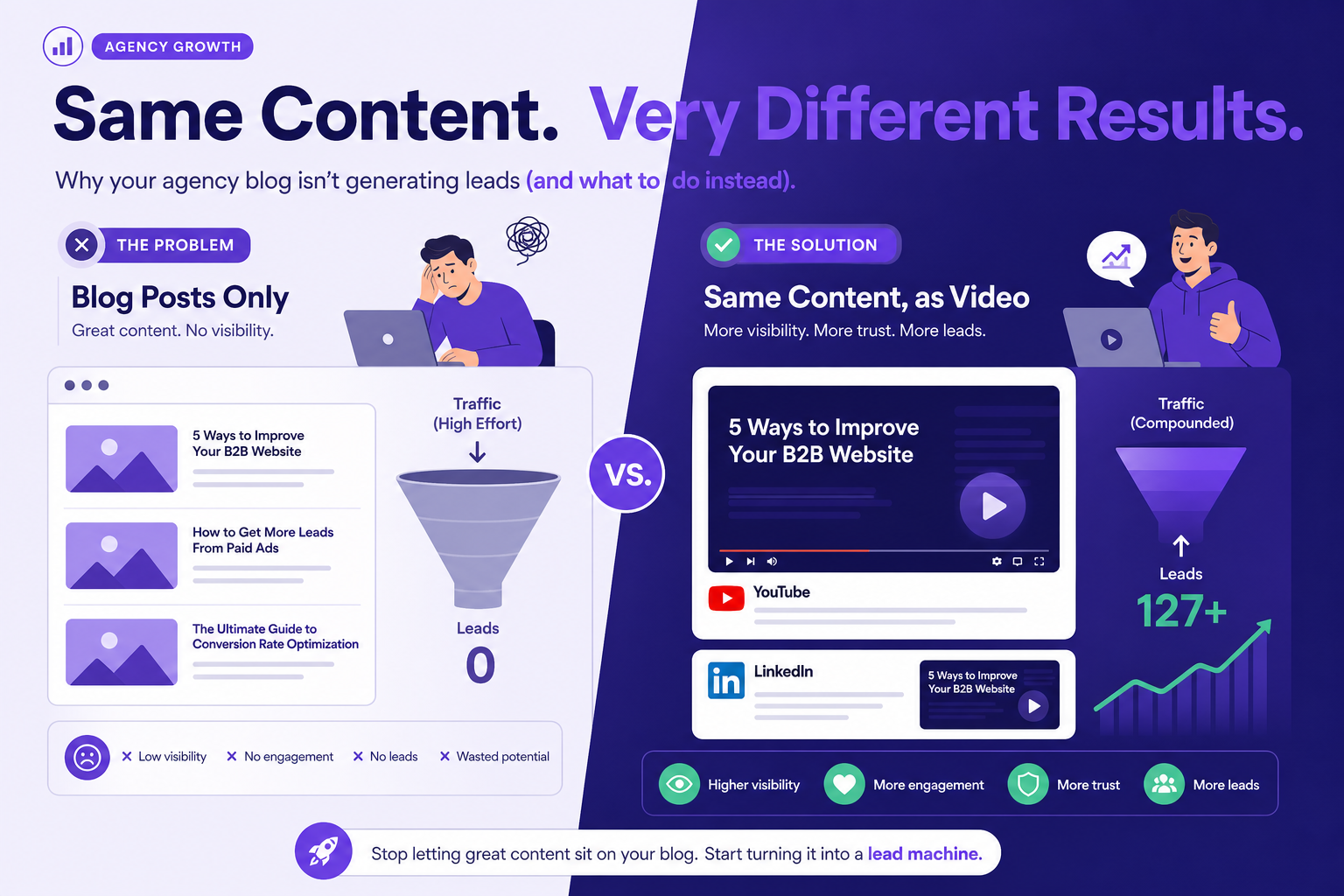
Most agency-produced blog posts underperform not because the content is bad, but because text-only content misses the distribution channels where buyers actually spend their time. Here's the fix.
Overview
TL;DR: Client blog posts underperform not because the writing is weak, but because text-only content never reaches the video-first channels (YouTube, LinkedIn, email) where buyers actually spend time. The fix is repurposing existing posts into video — no new writing required.
Your client approved the blog post. You published it. You shared it on social. Six months later, it has 80 organic visits per month and zero attributable pipeline.
This is the most common conversation in content marketing, and most agencies respond to it the same way: better SEO, more posts, better distribution. All of those are valid. But they all require more writing.
There's a different problem worth diagnosing first — one that doesn't get discussed because the fix isn't about writing.
The Real Problem: Text-Only Content Misses Half the Buying Journey
Your clients' buyers are on YouTube, LinkedIn video, and short-form video platforms for a significant portion of their research time. These are discovery channels that written content structurally cannot access.
A blog post that ranks on page 1 of Google for a competitive B2B term gets seen by buyers actively searching. YouTube is a different behavior — it serves content to buyers before they know to search, through suggested video and channel subscriptions. The same buyer who never searches Google for your client's keywords might watch 12 related YouTube videos a week.
Video isn't just a "format preference" issue. It's a distribution channel that written content doesn't reach, which means some buyers will never find your client's content regardless of how well it's written or how well it ranks.
Why Agencies Don't Fix This (And Why They Should)
The standard agency objection to video is cost. Video production runs $800–$4,000 for a professional 60–90 second piece. Multiply that by the content volume most retainers require and the math doesn't work.
That cost assumption is outdated. AI video tools in 2026 convert an existing blog post into a professional branded video for roughly $4–$8 per render, with a 15–30 minute account management time investment per piece.
The economics now work. The question is whether your agency is set up to deliver it.
What "Adding Video" Actually Looks Like
This isn't about producing talking-head videos or adding live production to your service stack. The specific workflow is:
1. Take the approved blog post — same content the client already reviewed
2. Convert it to video using a tool like Article Video Studio — paste the URL, select a visual template, generate
3. Review and export — MP4 for YouTube/LinkedIn, PDF for LinkedIn carousel, PNG for social assets
4. Distribute — upload to YouTube with matching keyword title, post native video on LinkedIn, embed in the original blog post
The client's written content becomes a multi-channel distribution package. The blog post now has a second life on platforms it couldn't reach before.
The Lead Attribution Argument
"We can't attribute leads to video" is the objection you'll hear from performance-oriented marketing directors. It's worth addressing directly.
First, attribution for organic content is already imperfect. Most last-touch attribution models credit a branded Google search or direct visit — not the blog post the buyer read six months earlier that first put the company on their radar. Video has the same attribution challenge as top-of-funnel written content.
Second, YouTube does provide data that blog posts rarely match: watch time, retention curves, clicks from the video to the website, and subscriber behavior. A buyer who watches 80% of a 4-minute explainer video about your client's product is demonstrating stronger engagement than a buyer who "visited" a blog post for 45 seconds.
Third — and most practically — the question isn't "can we prove video generated leads?" The question is "are our buyers on YouTube and LinkedIn video?" For almost every B2B category, the answer is yes.
The Content That Works Best as Video
Not every blog post converts equally well. The best candidates:
Strongest video conversion:
1. Explainer posts ("How [topic] works," "What is [concept]")
2. Process posts ("Step-by-step guide to X")
3. Case study summaries (condensed narrative of results)
4. Industry trend analysis (data-driven content that benefits from visual framing)
5. FAQ compilation posts (structured Q&A translates well to video segments)
Weaker video conversion:
1. Listicles with no connective narrative (hard to make cohesive as video)
2. Long-form glossary/dictionary content (too shallow per point for video pacing)
3. Highly technical documentation (requires specialist voice work to land well)
For most clients, 40–60% of their blog archive falls into the "strong video conversion" category. That's the pipeline.
Reframing This to the Client
The way you present this determines whether the client buys it or defers it. Two framings that work:
The platform access framing:
"Your blog reaches people who search for you. YouTube and LinkedIn video reach people who don't know to search yet. We're not replacing the blog — we're connecting it to distribution channels it can't reach on its own."
The content waste framing:
"You've spent [X] on content creation over the past two years. That investment is mostly living in a blog archive that gets incremental traffic. Video repurposing is the fastest way to extend the ROI on content you've already paid for."
The first framing works with growth-focused clients. The second works with efficiency-focused clients. Know which one you're talking to.
What to Deliver as a Proof of Concept
Before pitching this as an ongoing service, do one video for free (or at cost) to show the output.
Pick the client's highest-traffic blog post, convert it in Article Video Studio using their nearest brand equivalent template, and send them the MP4 with a note:
"This is 25 minutes of work. Here's what your top post looks like as video. Want to see what it does on YouTube over the next 60 days?"
This approach:
1. Removes the skepticism from abstract claims
2. Shows exactly what the output looks like (which always surprises clients in a positive way)
3. Creates a 60-day test case with measurable outcomes
4. Positions you as proactive and technically ahead of what they expected
The conversion rate on this proof-of-concept approach is high because the output sells itself.
Common Objections and Responses
"We tried video before and it didn't work.": Find out what they did. Most prior video failures were either inconsistent posting, low visual quality, or no distribution strategy beyond "post it." This is a different approach: systematic conversion of proven written content, not original video production.
"Our audience doesn't watch video.": Verify this assumption. YouTube is the second-largest search engine. LinkedIn's native video consistently outperforms text posts in reach. The audience is there — the question is whether the client has content in the format they consume.
"We don't want to dilute our brand with AI-generated content.": The output is branded video that uses the client's own content. The AI handles conversion and narration, not content creation. Every word in the video came from content the client approved. The visual style is controlled by the template selection. Frame it as "AI-assisted production," not "AI-generated content."
"Our legal/compliance team needs to review everything before it goes live.": Article Video Studio's output is reviewable before export. Build a compliance review step into the workflow — the video goes through the same review chain as the written post. Most compliance reviews for video content based on approved written content take 30–60 minutes.
Frequently Asked Questions
How long does it take to add video to an existing content program?
With Article Video Studio, the first video typically takes 45–60 minutes including setup, calibration, and review. By the third video for a given client, you're at 15–20 minutes per piece.
What if the blog post is gated or behind a login?
Article Video Studio accepts pasted text as well as URLs. Paste the content directly for gated assets.
How do we handle clients who want custom music or voiceover?
Article Video Studio includes an AI voice library. For clients who want a custom voice or music track, that can be added post-export in a standard video editor. Factor in the additional production time when scoping those projects.
Does adding video to a blog post hurt its SEO?
No — it helps it. Embedding a video increases average time-on-page, which is a positive signal. If the video is also hosted on YouTube with a backlink to the page, you get an additional referring domain from Google's own platform.
How should we report on video performance to clients?
YouTube Analytics provides watch time, traffic source, and click-through data. LinkedIn provides native video views, engagement rate, and profile clicks. Report these monthly alongside blog traffic. Over time, video watch time is one of the strongest signals of content resonance you can show a client.