Behind the scenes
The Trojan Horse: How a Story Beat an Army
For ten years no army could break the walls of Troy — then a single story walked through the front gate. We retold the fall of Troy as a two-minute stickman short, plus what the oldest trick in war teaches about reaching a guarded audience.
Overview
For ten years, no army on earth could break the walls of Troy. Then someone told a story.
The Greeks had everything an invading force could want: a thousand ships, legendary warriors, a decade of relentless siege. And it bought them nothing. The walls of Troy had never been breached, and it seemed they never would be. No sword, no spear, no battering ram could bring them down.
What finally opened the gates wasn't strength. It was an idea.
The cleverest man in the army
Odysseus, the cleverest of the Greeks, understood something his generals didn't: if the walls could not be broken from the outside, they would have to be opened from within. And nobody inside Troy was going to open them for an army.
But they might open them for a gift.
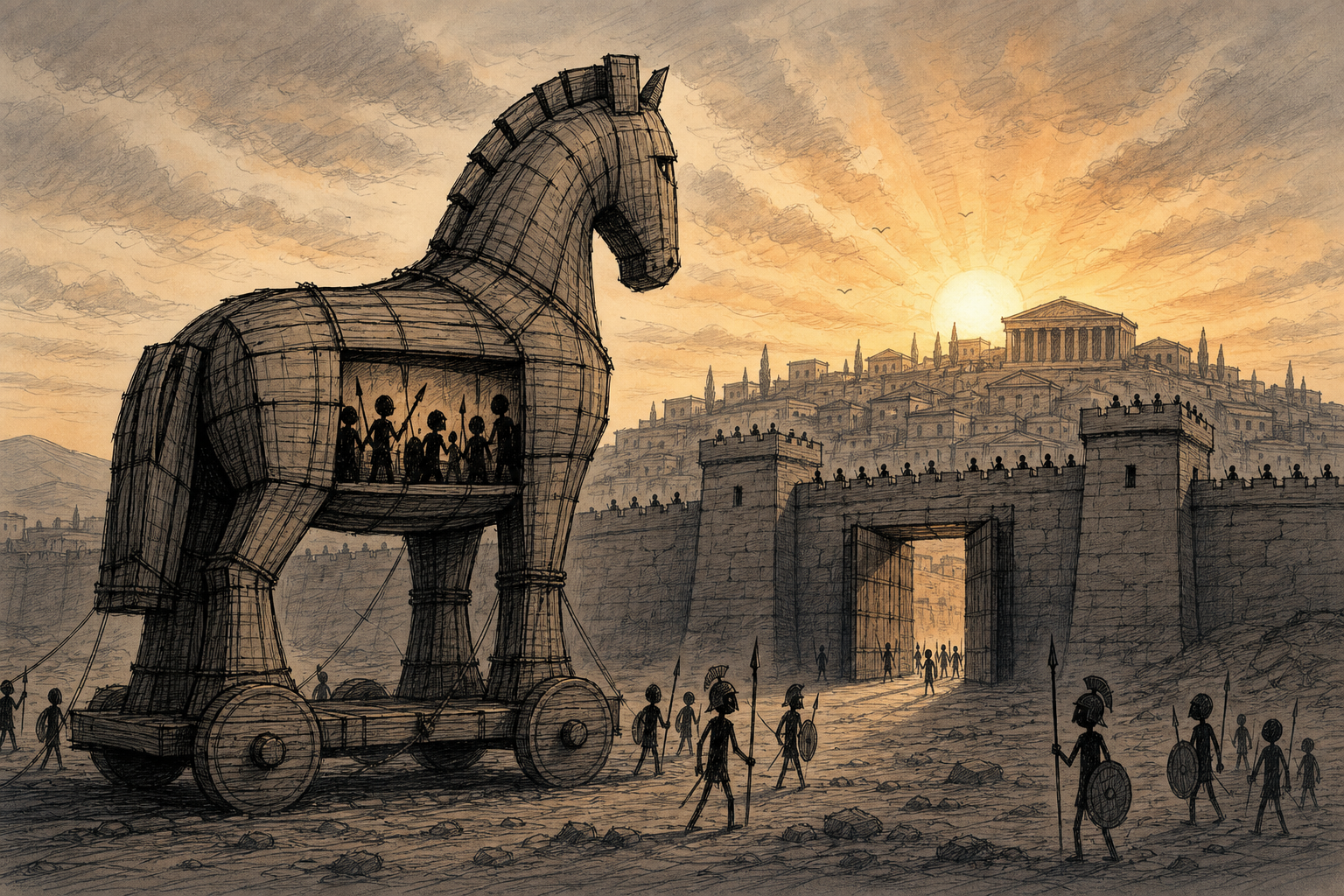
So the Greeks built a horse. A great horse of planks and beams, taller than the gates themselves, with a belly deep enough to hide their bravest warriors. Then they burned their camp, boarded their ships, and sailed away — leaving the horse standing alone on the shore.
When the Trojans woke, the enemy was gone. Ten years of war, over, just like that. And on the empty beach stood a magnificent horse. A tribute to the gods, they decided. An offering of peace. So they tied ropes to it and dragged it — singing as they pulled — through the very gates no army had ever passed.
That night, Troy celebrated as it had never celebrated before.
And in the dead of night, when the songs had faded and the whole city lay asleep, the belly of the horse creaked open. One by one, the hidden warriors slipped down into the silent square, crept through the sleeping city, and swung the great gates wide open — to the army waiting in the dark.
Troy fell in a single night. Not to swords. Not to armies. To a wooden horse, and a well-told lie.
Did it actually happen?
Here's where it gets interesting: scholars think the tale may be rooted in fact.
Homer never mentioned the horse in the Iliad, his first account of the war — it first appears in Virgil's Aeneid, and Homer picked the tale up later in the Odyssey. But siege engines were very real in that era: movable wooden structures used to batter walls and gates, often draped in hides — including horsehides — to protect them from flaming arrows. A "wooden horse" that breaks open a city starts to sound less like fantasy and more like a poet's memory of a real machine.
There's an even better theory. Ships of the period were commonly decorated with horse heads on their prows — Homer's Odyssey even calls ships "seahorses." A ship makes a far more practical hiding place for three dozen warriors than a giant statue on wheels. The "horse" that carried hidden Greeks may simply have sailed in.
Wooden horse, disguised ship, or pure invention — the story outlived the city, the war, and the civilization that told it. Three thousand years later, we still call a threat hidden inside something harmless a Trojan horse. Your antivirus software is, right now, hunting for a myth.
The lesson nobody talks about
The Trojan Horse is usually told as a warning: beware of Greeks bearing gifts. Fair enough.
But flip it around and it's something else entirely: the most fortified walls in the ancient world were opened by a story. Ten years of force achieved nothing. One compelling narrative walked straight through the front gate — because people don't raise their defenses against a story. They pull it inside and celebrate it.
That's still true. Your audience is Troy: walls up, attention guarded, immune to being battered with ads and cold pitches. Force doesn't get through. Stories do.
Watch the myth — then tell yours
We retold the fall of Troy as a narrated stickman short — the siege, the idea by the campfire, the horse rising on the shore, the hatch creaking open at midnight — all in under two minutes.
It was made with Article Video Studio, which turns blogs, docs, and newsletters into narrated videos in minutes. Your story can open gates too.
Turn it into a video at articlevideostudio.com.
Frequently Asked Questions
Who is this guide for around trojan horse myth animation?
It is designed for written-first creators and teams who already have source material and want a repeatable path into video rather than a prompt-only workflow.
Does this help with fall of Troy stickman short?
Yes. Each article is written to help you turn one content asset into multiple formats while keeping the original message intact.