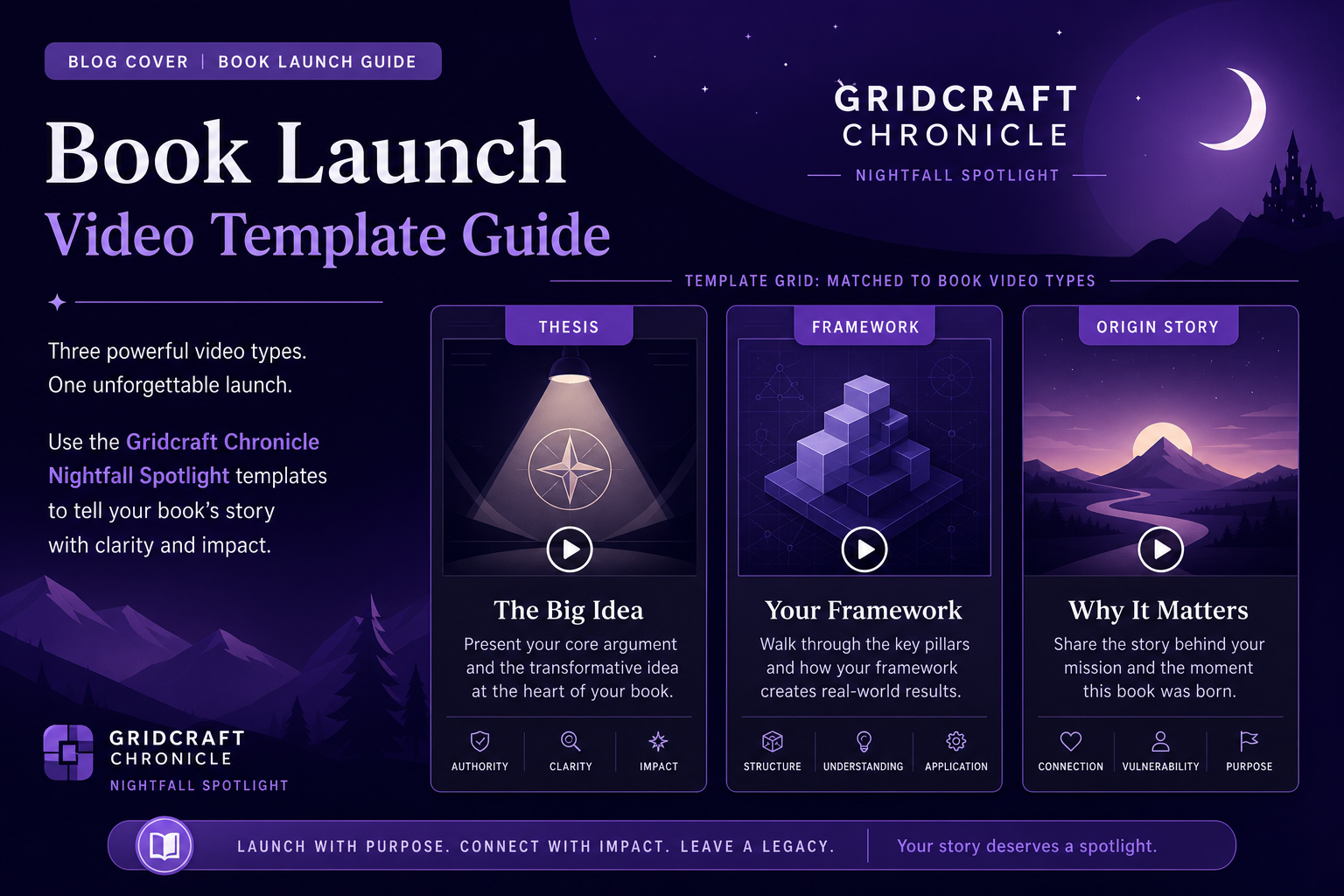
Template guide
Which Article Video Studio Template Fits a Book Launch? A Guide for Nonfiction Authors
A practical guide to choosing the right Article Video Studio template for each type of book launch video — thesis videos, framework demos, research breakdowns, origin stories, and social clips.
Overview
TL;DR: A practical guide to choosing the right Article Video Studio template for each type of book launch video — thesis videos, framework demos, research breakdowns, origin stories, and social clips.
The visual template you choose for your book launch video isn't just an aesthetic decision. It's a positioning decision — it tells the viewer in the first 3 seconds what kind of content this is and whether to keep watching.
Different types of book launch video content warrant different template choices. Here's a practical guide for matching your video type to the right visual style.
Why Template Choice Matters for Authors
Your book has a specific audience with specific expectations. A business strategy book signals credibility differently from a self-help book. A research-backed science title needs a different visual language than a narrative-driven memoir-adjacent nonfiction title.
The wrong template doesn't just look off — it subtly undermines the trust signal your book content is trying to build. A fast, kinetic template on a measured, evidence-heavy thesis video creates dissonance. A slow, academic template on a punchy contrarian take loses the energy the argument needs.
The right template amplifies the content. The wrong one fights it.
The Five Book Launch Video Types and Their Ideal Templates
1. The Thesis Video: "Here's What My Book Argues"
What it is: A 3–6 minute video that states your book's central argument, provides supporting evidence, and makes the case for why the argument matters.
Audience: New viewers who don't know your book exists; buyers who are considering the purchase.
Best template: Gridcraft or Chronicle
Why Gridcraft: Your thesis video needs to be taken seriously before it's engaged with. Gridcraft's editorial structure — clean grid layout, organized information hierarchy — signals that this is serious, analytical content. It's professional without being intimidating.
Why Chronicle: If your book is heavily research-backed or academic-adjacent, Chronicle's document-forward visual style signals the rigor of the underlying work. For science, economics, history, or evidence-based business content, Chronicle positions the video as research, not just opinion.
What to avoid: Spotlight or high-energy kinetic templates. Your thesis video is making an argument, not announcing an event. High energy templates can undermine the credibility of careful analysis.
2. The Framework Demo: "Here's How the System Works"
What it is: A step-by-step walkthrough of the main framework, model, or system your book introduces.
Audience: People who learn through structured, sequential content; potential buyers who want to see the system before committing.
Best template: Geometric Explainer
Why: Geometric Explainer is built for step-by-step content. Each step appears clearly in sequence, with supporting visuals that reinforce the logic of the progression. The clean whiteboard-adjacent aesthetic signals "this is educational" rather than "this is promotional" — a crucial distinction for framework demos.
Alternative: Gridcraft also works well for framework content, particularly when the framework has parallel components that benefit from a grid-style visual comparison.
What to avoid: Nightfall or Chronicle, which are designed for depth and research, not sequential step-through content.
3. The Research Video: "Here's What the Evidence Shows"
What it is: A video presenting the key studies, data, or evidence that supports your book's central argument.
Audience: Skeptical buyers who want to see the evidence before committing; academics and professionals who respond to research-forward content.
Best template: Chronicle or Nightfall
Why Chronicle: Chronicle's document-forward visual style frames the content as research rather than opinion. For books with strong empirical backing, Chronicle tells the viewer immediately that what follows is evidence-based. The data graphics in Chronicle scenes reinforce this by placing numbers and statistics in a visual context that highlights their significance.
Why Nightfall: If your research has a premium, exclusive quality — studies few people know about, original research you conducted, proprietary data — Nightfall's dark, premium aesthetic signals that this is not common knowledge. The cinematic quality of Nightfall positions the content as genuinely valuable rather than widely available.
What to avoid: Spotlight or high-energy templates, which undermine the credibility of evidence-based content.
4. The Origin Story: "Why I Wrote This Book"
What it is: A narrative video telling the story of what led you to write the book — the experience, frustration, discovery, or question that made the book necessary.
Audience: Readers who connect through personal narrative; buyers who want to know the author, not just the argument.
Best template: Nightfall
Why: Nightfall's cinematic visual quality suits narrative content. The deep backgrounds and atmospheric feel create a viewing experience that's closer to storytelling than analysis. Origin story videos are inherently more emotional and personal than thesis or research videos — Nightfall's aesthetic matches that register.
Alternative: Chronicle can work if the origin story is primarily intellectual (you were studying something, found an anomaly, pursued it) rather than personal. For personal narrative, Nightfall is the stronger choice.
5. The Short-Form Clip: Big Ideas in 60 Seconds
What it is: A 60–90 second video capturing the most surprising, interesting, or contrarian idea from the book. Designed for Instagram Reels, YouTube Shorts, TikTok, or LinkedIn short-form.
Audience: Platform-native scrollers who are discovering you for the first time.
Best template: Spotlight
Why: Short-form content competes in the most attention-constrained environment in content. Spotlight's bold kinetic typography and fast visual rhythm match that environment. An idea that's mildly interesting becomes arresting in Spotlight's visual format — the bold text hitting the screen commands attention in a way that softer visual styles can't.
What to avoid: Chronicle or Geometric Explainer — these visual styles are too patient for short-form content. They reward viewers who are already committed to watching; short-form requires capturing viewers who are about to scroll.
Template by Nonfiction Book Category
Different book categories have audience expectations that map to specific templates:
Business / strategy — Primary Template: Gridcraft · Secondary Template: Nightfall
Economics / finance — Primary Template: Nightfall · Secondary Template: Chronicle
Science / research — Primary Template: Chronicle · Secondary Template: Geometric Explainer
Self-help / personal development — Primary Template: Geometric Explainer · Secondary Template: Gridcraft
History / narrative nonfiction — Primary Template: Nightfall · Secondary Template: Chronicle
Leadership / management — Primary Template: Gridcraft · Secondary Template: Chronicle
Health / wellness — Primary Template: Geometric Explainer · Secondary Template: Gridcraft
Technology / AI — Primary Template: Nightfall · Secondary Template: Gridcraft
These are starting points, not rules. The most important test is whether the template makes your specific content look better or worse. Run the first video in your primary template; if it doesn't feel right for your content, switch.
The One Consistency Rule
If you produce multiple videos from your book, use the same primary template throughout. Consistency builds brand recognition — after 10 videos in Gridcraft, viewers associate that visual style with you and your book. Switching templates between videos resets that recognition.
The practical recommendation for authors starting out:
- Pick your primary template based on your book category
- Produce your first 3 videos in that template
- If you're happy with how they look and feel, commit to it
- If something feels off, switch to your secondary template
- Once committed, don't switch
Setting Up Your Production Workflow
Once you've identified your template, the production setup for each book video is:
1. Select the book excerpt or chapter section (300–800 words)
2. Go to articlevideostudio.com → New Project
3. Paste the text or URL
4. Apply your established template
5. Apply your established narrator voice (pick one and keep it)
6. Generate → review → export
7. Publish with a title optimized for the video's specific argument (not the book title)
At 30–45 minutes per video, producing 4 videos per month from your book content is approximately 2 hours of production time — sustainable alongside writing a second book.
Frequently Asked Questions
What's the single most important template to get right for a book launch?
The thesis video template — because it's the video that represents your book's core argument to the widest audience. Spend the most time calibrating this one. The other video types can be adjusted more easily.
Can I use the same template I used for a previous book if I'm launching a new one?
Yes, with one consideration: if your previous book used a specific template as part of its brand, viewers may associate that template with the previous book rather than the new one. Switching to a secondary template for a new book can signal to viewers that this is new work, not a continuation of the old.
What if my book covers multiple topics that need different visual styles?
Commit to one template per book, even if different chapters feel like different template fits. The consistency signal is more valuable than the per-video optimization. Use the template that best fits the majority of your content.
Should my book's video template match my newsletter or website aesthetic?
If possible, yes. The closer the video template is to your existing brand, the more cohesive the viewer experience for people who encounter you across multiple channels. If your newsletter has a dark, premium aesthetic, Nightfall is the obvious choice. If your website is clean and editorial, Gridcraft will feel consistent.
How do I find out which template other authors in my genre use?
Search YouTube for authors in your genre who are active on video. Look at their template choices and ask which ones signal the right kind of credibility for your topic. The nonfiction YouTube space is small enough that a few hours of research will give you a clear picture of the visual norms in your category.